
You fade a stretch away from VWAP, it snaps back, and you win. You do it again and win again. Six trades in ten work, and after a few hundred trades the account is still down thousands.
Traders who fade VWAP tend to blame the days it doesn't come back, the trend days. We wanted to know whether that's really where the money goes, and whether fading further out fixes it.
We tested the simplest version of the trade we could on SPY shares. We faded every 5-minute bar that closed outside the band and got out when price touched VWAP, with no stop. Here are the three bands, with costs included:
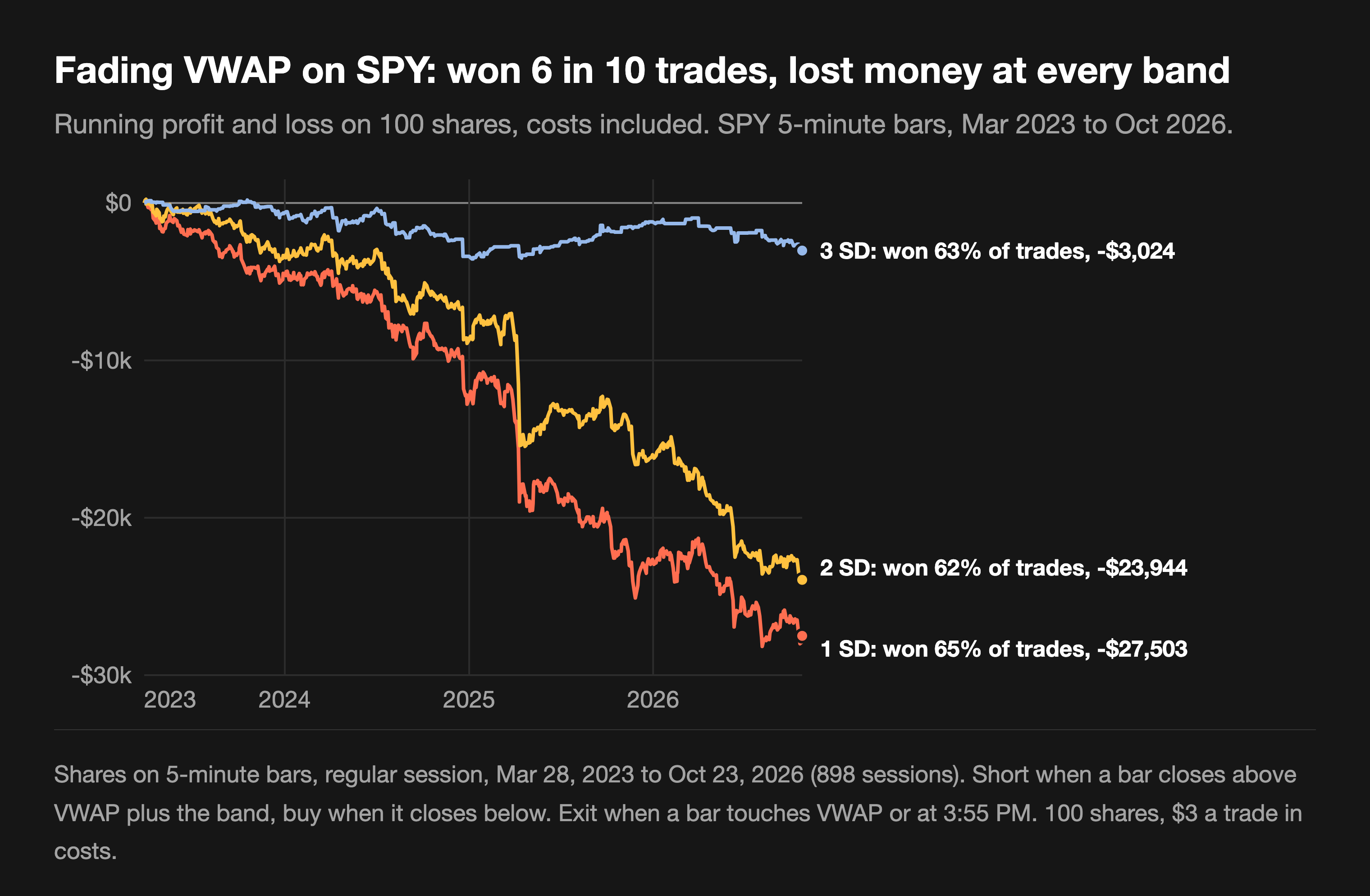
Winning 6 in 10 and still losing
The win rate never dropped below 62%, and the account lost at every band. The average loser was about twice the size of the average winner, every time.
When a fade works you take a small gain at VWAP. When it doesn't, price keeps going and you sit through the whole move. At a 60% win rate, a winner has to be at least two thirds the size of a loser just to break even. Here the winners were less than half.
You can open the runs signed out and look at the trades yourself: 1 SD, 2 SD and 3 SD.
The further out you fade, the more it keeps going
Going out to a wider band means fewer trades, and it also changes what happens after you get in. At 1 SD, about 1 in 6 trades never got back to VWAP before the close. At 2 SD it was 1 in 4, and at 3 SD it was more than 1 in 4.
So a wider band is a bigger bet that the stretch is the exception. The extra distance doesn't make the snap-back more reliable. The 3 SD row lost the least, but it only has 275 trades, and when we resampled it, 14% of the rebuilt runs ended up above zero. We wouldn't read much into that row.
It wasn't the trend days
Only 17 of the 898 sessions closed beyond the 2 SD band, and none of the 10 worst 2 SD trades happened on those days.
The worst damage came from fast reversal days instead. The clearest example was April 7 to 9, 2025, the tariff whipsaw. Fading at 2 SD on April 9 lost about $2,400 before costs on 100 shares, in one day.
A stop at 3 SD made it slightly worse
We also ran the 2 SD fade with a stop at the 3 SD band. It took more trades (2,019), cut the win rate to 54%, and the net was slightly worse, at -$25,167. Losers shrank to 1.5x the winners, but with only 54% of trades winning, that was still too big. The run is here.
Costs and sample size
It's one stock over 3.6 years, and the 3 SD row is small. At 1 SD, $9,951 of the $27,503 loss was commissions, $3 a trade over 3,317 trades. Before costs it still lost $17,552.
If you want to run the same test on another ticker or a different band, you can build it in the Tester on TraderPier.
How we tested it
SPY shares, 5-minute bars, regular session, March 28, 2023 to October 23, 2026, which is 898 sessions. VWAP is built on the average of each bar's high, low and close, restarts at 9:30 AM, and the bands are volume-weighted standard deviations around it.
We short when a 5-minute bar closes above VWAP plus k standard deviations and buy when one closes below VWAP minus k. Signals run from the 6th bar of the day to the 3:40 PM bar. We exit when a bar touches VWAP, filled at the next bar's open, or at 3:55 PM if it never does. The main runs have no stop. Each trade is 100 shares with $3 in costs.