
Everyone has had that moment where price just stops you out to the tick, only for it to reverse back to your original target, and it's the market that's out to get you.
How often does that really happen? To find out we backtested the plainest breakout we could think of. When the first five minute bar closed, we placed a stop buy one tick above the high, and a stop sell one tick below its low. Whichever filled first, the other would become the stop. If stops get hunted, a stop that tight is the easiest one to hit.
We counted a stop-out as a reversal when the stock closed the day in the green on the trade: above where you got in for a long, below it for a short. Left open instead of stopped, that trade would have finished the day in profit. We didn't track whether it reached a profit target, only where the day closed.
AMZN, Oct 8: out by a cent at 10:34 AM
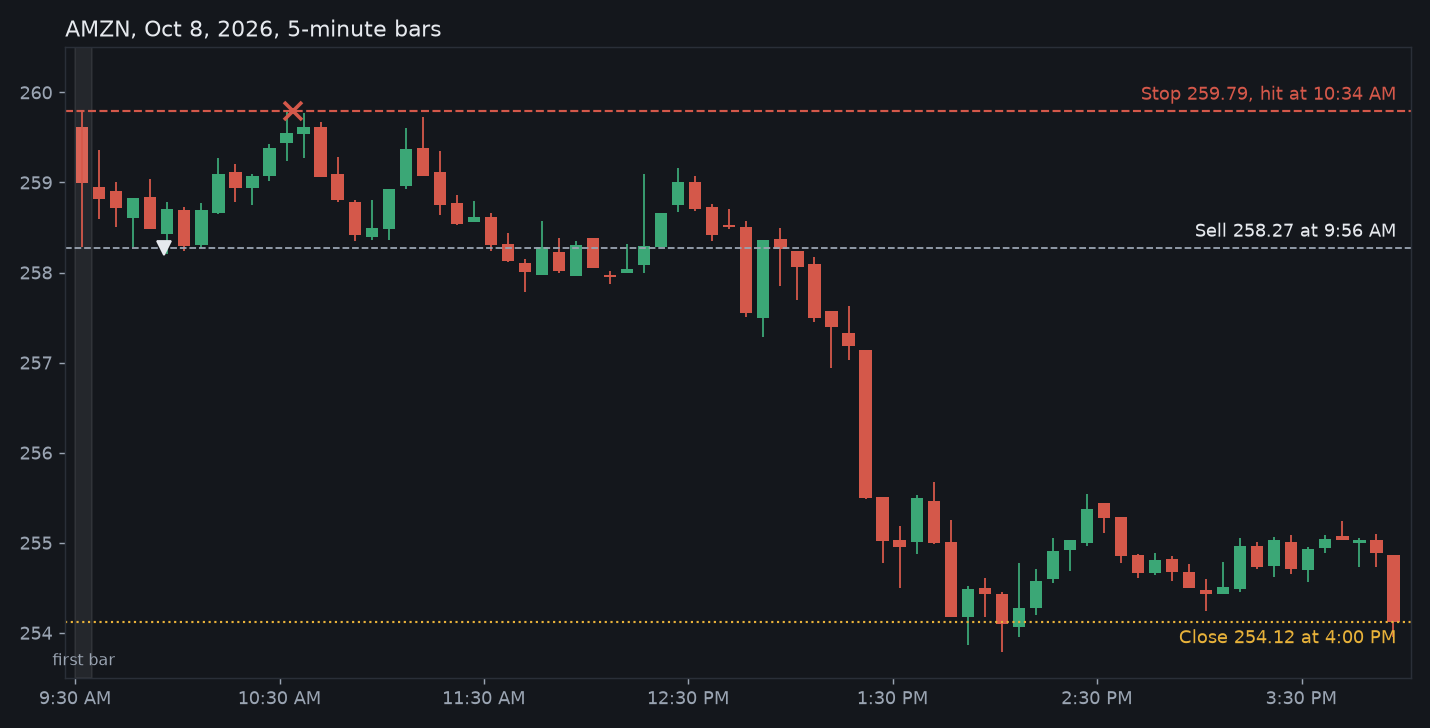
The first bar that morning ran from 259.78 down to about 258.29. At 9:56 AM AMZN traded 258.27, so we went short with the stop at 259.79.
Look at the top of the chart. At 10:34 AM AMZN traded exactly 259.79 and the 100-share short was stopped for $152, a full 1R. It didn't trade a cent higher that day. For the next two hours it sat between about 257.80 and the stop. After 12:45 PM it sold off and closed at 254.12.
A stop one cent higher, at 259.80, never gets touched, and the same short makes $415 by the close. You can step through the 10:34 AM minute yourself, and open other past days the same way in Market Replay.
The other 4,019 stop-outs
We ran the same rule on 7,139 trades. A bit over half got stopped out, and more than one in four of those stop-outs (27.6%) closed the day in the green on the trade. About one in seven (14.9%) closed at least 1R in profit.
Almost none were like AMZN, where price reversed right at the stop, hitting it to the tick but never going past it. If someone were hunting the stops, price would tag them and turn. Of the 4,020 stop-outs, 33 did that, under 1% and fewer than one a month across all ten tickers. 17 of those 33 closed the day in the green on the trade.
SPY got stopped out the most, three trades in four. AMZN got stopped the least. Here are all ten:
| Ticker | Trades stopped out | Of those stop-outs, closed the day in the green on the trade |
|---|---|---|
| SPY | 75.1% | 38.4% |
| QQQ | 68.2% | 32.4% |
| IWM | 61.0% | 26.6% |
| AAPL | 48.1% | 20.2% |
| MSFT | 48.6% | 25.1% |
| META | 49.6% | 26.1% |
| NVDA | 52.0% | 22.3% |
| TSLA | 49.6% | 23.4% |
| AMD | 52.1% | 29.0% |
| AMZN | 42.1% | 14.0% |
The share of stop-outs that closed the day in the green on the trade was 26% to 30% in each of the four years (2023 and 2026 are partial years). The ticker mattered more, and the data doesn't say why. AMZN also has only one year of data.
Widening the stop
Then we tried the obvious fix. We pushed the stop further out, from 10% up to 100% of the bar's range, and cut the share count so each trade still risked the same amount.
| Stop past the other side of the bar | Trades stopped out | Winners | Average R per trade |
|---|---|---|---|
| 1 cent (the rule above) | 56.3% | 36.0% | +0.062 |
| +10% of the bar's range | 53.5% | 37.4% | +0.043 |
| +25% | 48.6% | 39.9% | +0.048 |
| +50% | 41.6% | 43.1% | +0.048 |
| +100% | 30.6% | 46.9% | +0.039 |
The widest stop got hit about 30% of the time instead of 56%, and 47% of the trades won. Those trades also made the least. Before costs, the trades made less with every wider stop than with the one-cent stop.
How we tested it
We took one trade a day, and anything left open was filled at the close.
The tickers are SPY, QQQ, IWM, AAPL, MSFT, META and NVDA, from March 28, 2023 to October 22, 2026. TSLA starts in December 2023, AMD in November 2024 and AMZN in October 2025. The prices are Databento trades, rebuilt into 1-minute bars so we could tell whether the entry or the stop came first. Four trades hit both the long and the short trigger in the same minute and we skipped them, and six never triggered.
The 33 stop-outs are the ones where price tagged the stop and turned, never trading more than a cent past it for the rest of the day. If you allow 10 cents past the stop instead of one, it's 142 stop-outs, 3.5% of them, and 82 of those closed the day in the green on the trade.
These numbers are before commissions and slippage, and with a one-cent stop you trade the most shares for the same risk, so costs bite hardest (we looked at that here). It's one rule on ten big, liquid tickers with day-long holds.